キーワード / Keywords
1. OLED(有機EL) / Organic Light-Emitting Diode
日本語: 有機分子へ電気を流して発光させる薄型デバイスです。分子設計と励起エネルギーの流れを整えることで、明るさ、色純度、消費電力を改善できます。
English: A thin light-emitting device in which organic molecules convert electrical energy into light through controlled excited-state processes.
2. 励起子(Exciton)
日本語: 電子と正孔が結び付いた、発光のもとになるエネルギー状態です。光へ変換されず熱として失われる励起子を減らすことが、高効率OLEDの鍵です。
English: A bound electron-hole excited state that provides the energy for light emission and must be efficiently harvested to reduce losses.
3. TADF(熱活性化遅延蛍光) / Thermally Activated Delayed Fluorescence
日本語: 熱エネルギーを利用して三重項励起子を一重項へ戻し、蛍光として活用する仕組みです。希少金属に頼らず高効率化できる方法として注目されています。
English: A mechanism that thermally converts triplet excitons into emissive singlet states, increasing the fraction of electrical energy used for fluorescence.
4. ハイパーフルオレッセンス(Hyperfluorescence)
日本語: 励起子を効率よく集める増感材料から、色純度の高い発光材料へエネルギーを渡す方式です。高効率と鮮やかな発光の両立を目指します。
English: An OLED strategy that transfers energy from an efficient sensitizer to a narrowband terminal emitter for efficient, color-pure emission.
5. ホット励起子(Hot Exciton)
日本語: 通常より高いエネルギー準位にある励起子です。低い準位へ落ちる前に発光へ利用できれば、変換経路を短縮し、非放射損失を抑えられます。
English: A higher-energy exciton that can be harvested before relaxing to lower states, potentially accelerating conversion and limiting nonradiative loss.
日本語版
導入
OLEDでは、電気によって生じた励起子をどれだけ光へ変えられるかが、発光効率を左右します。特に三重項励起子は、そのままでは通常の蛍光へ使いにくいため、TADF、金属錯体、エキサイプレックスなどを利用して一重項へ変換し、発光材料へエネルギーを届ける研究が進められています。
ここで紹介する三つの研究は、赤色OLED用パラジウム錯体、高い励起状態を利用する青色ホット・エキサイプレックス、赤色発光材料におけるホット励起子の直接的な観測を扱っています。共通するのは、励起子がどの準位を通り、どの速さで変換され、どの発光分子へ渡されるかを分子設計によって制御する考え方です。
研究内容
1. パラジウム錯体で高効率な赤色発光とエネルギー移動を実現
Pd(II)-TADF Complexes With Metal-Perturbed Intraligand Charge Transfer State: Emitters and Sensitizers for High-Efficiency Red OLEDs
- 分子内のねじれ角が異なる複数のパラジウム錯体を合成し、励起状態と発光性能の関係を調べました。
- 金属の影響を受けた配位子内電荷移動状態を利用し、一重項と三重項のエネルギー差を0.05~0.26 eVの範囲で調整しました。
- Pd3と呼ばれる錯体は、赤色TADF、82%の発光量子収率、1.13 µsの発光寿命を示しました。
- 下部発光型OLEDでは617 nmの赤色発光と、最大外部量子効率30.15%を達成しました。
- 1000 cd/m²での効率低下は2.32%に抑えられました。
- 上部発光型のITOフリーOLEDでは、色度座標の赤成分が0.68を超える純赤色発光と、最大外部量子効率38.68%を示しました。
- Pd3を増感材料として使ったハイパーフルオレッセンスOLEDでも、最大外部量子効率27.06%と小さな効率低下が得られました。
2. 高い三重項準位を使う「ホット・エキサイプレックス」
Hot-Exciplex: A New Regime of Triplet Harvesting Beyond Conventional TADF Advancing Hyperfluorescence
- 電子を与える分子と受け取る分子が励起状態で形成するエキサイプレックスを、青色OLEDの増感材料として設計しました。
- ビスピリミジン構造のBisPMDをアクセプター、カルバゾール誘導体CCPをドナーとして用いました。
- 両分子の高い三重項エネルギーを近づけることで、高エネルギーの励起状態へアクセスできる構造としました。
- ピコ秒・ナノ秒領域の過渡吸収測定により、高い三重項準位を介する過程を確認しました。
- 高い準位で一重項と三重項のエネルギー差を小さくし、上位準位での逆項間交差を速めました。
- 青色TADF発光体と狭帯域の多重共鳴発光体に対して、効率的なフェルスター型エネルギー移動を実現しました。
- 高効率を保ちながら、高輝度時の効率低下と色純度を改善する増感方式としての可能性を示しました。
3. 赤色OLEDでホット励起子経路を直接検証
Direct Experimental Evidence of Hot-Exciton Channels via Anti-Kasha T2 Phosphorescence in High-Efficiency Red OLEDs
- ベンゾチアジアゾール系アクセプターと二種類のドナーを組み合わせ、非対称な赤色発光分子PPIPPとPPIPOXを開発しました。
- 局所励起と電荷移動が混ざったHLCT状態と、高い三重項準位の配置を利用しました。
- 低温測定で、通常は観測しにくい高位三重項T2からのリン光を直接確認しました。
- この「反カシャ型T2リン光」は、高位三重項が最低三重項へ直ちに失活せず残ることを示す証拠になりました。
- 強磁場下の磁気電界発光測定では、高位準位の逆項間交差に関係するスピン変換を支持する信号が得られました。
- 三重項同士の消滅は高位三重項を補充しますが、主要な励起子変換はホット励起子を介した逆項間交差であることが示されました。
- 高い準位を経由する発光機構を、分光測定とデバイス測定の両面から検証する指標を提示しました。
研究全体の意義
三つの研究は、OLEDの高効率化において、励起子の数だけでなく「どのエネルギー準位を、どの順番で、どの速さで通るか」が重要であることを示しています。パラジウム錯体では、分子のねじれと金属効果によって赤色TADFと増感機能を両立しました。ホット・エキサイプレックスでは、通常より高い準位を使って三重項を素早く回収し、色純度の高い発光体へエネルギーを渡しています。赤色発光材料の研究では、その高位準位経路を実験的に見分ける手掛かりが示されました。
これらの知見は、高色純度ディスプレイ、高輝度でも効率が落ちにくいOLED、青色・赤色発光材料の長寿命化に向けた設計基盤になります。今後は、発光層内のエネルギー移動と電荷輸送の両立、長時間駆動時の安定性、材料合成とデバイス製造の再現性を確認することが重要です。
English Version
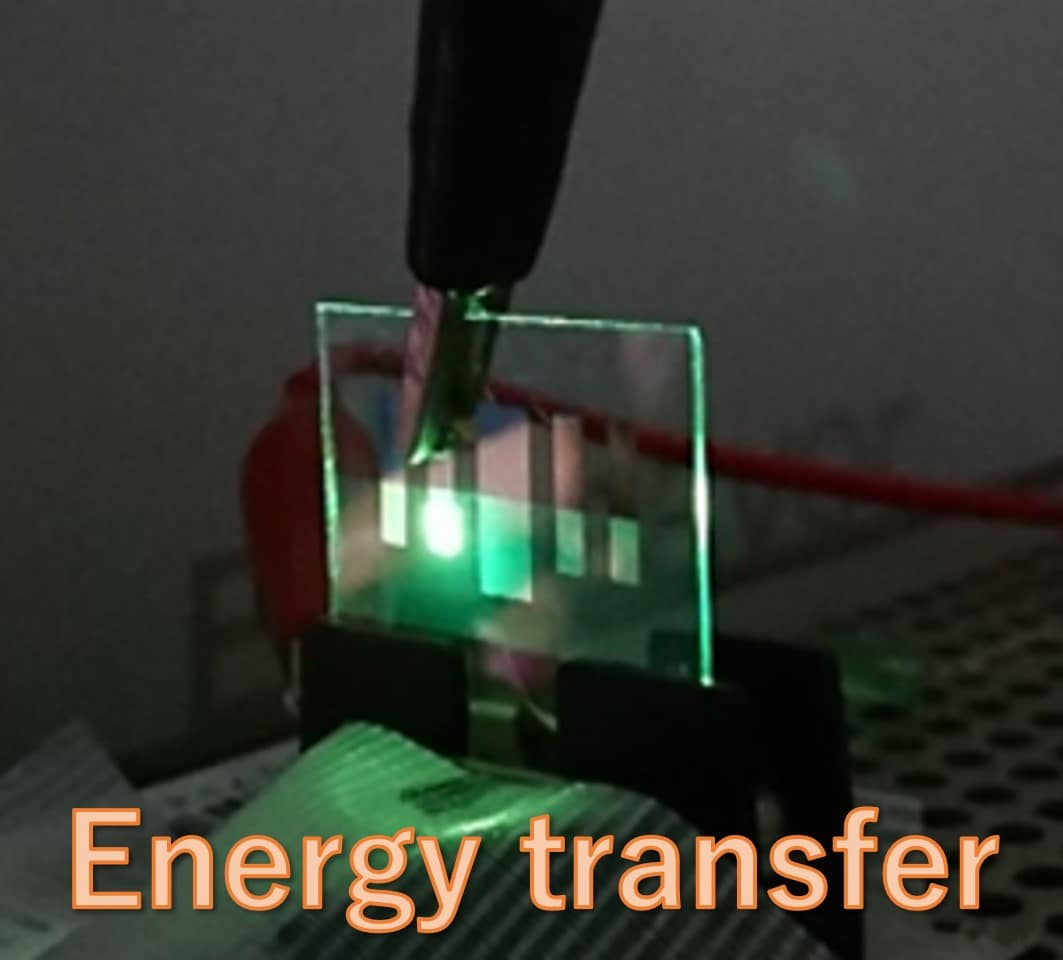
Understanding Energy Transfer in OLEDs: New Exciton-Control Strategies for Efficient, Color-Pure Emission
Introduction
OLED efficiency depends on how effectively electrically generated excitons are converted into light. Triplet excitons are especially important because they are not readily used by conventional fluorescence. TADF molecules, metal complexes, and exciplexes can convert or transfer this energy to emissive singlet states and terminal emitters.
The three studies highlighted here examine palladium complexes for red OLEDs, a blue hot-exciplex sensitizer using higher excited states, and direct experimental evidence for hot-exciton pathways in red emitters. Together, they show how molecular design can control which excited states are accessed, how rapidly spin conversion occurs, and where the excitation energy is ultimately delivered.
Research Highlights
1. Palladium Complexes Combine Efficient Red Emission and Sensitization
- A series of palladium complexes with different molecular torsion angles was synthesized to relate structure to excited-state behavior.
- A metal-perturbed intraligand charge-transfer state tuned the singlet-triplet energy gap from 0.05 to 0.26 eV.
- The Pd3 complex exhibited strong red TADF, an 82% photoluminescence quantum yield, and a 1.13 µs lifetime.
- A bottom-emitting OLED produced red emission at 617 nm with a maximum external quantum efficiency of 30.15%.
- Efficiency roll-off was limited to 2.32% at 1000 cd/m².
- A top-emitting, ITO-free OLED achieved pure-red emission with a red CIE coordinate above 0.68 and a maximum external quantum efficiency of 38.68%.
- Pd3 also sensitized a red multi-resonance emitter in a hyperfluorescence OLED, reaching 27.06% maximum external quantum efficiency with suppressed roll-off.
2. A Hot-Exciplex Uses Higher Triplet States for Blue Hyperfluorescence
- A donor-acceptor exciplex was designed as a sensitizer for blue OLEDs.
- BisPMD served as the acceptor and the carbazole derivative CCP as the donor.
- Their similar high triplet energies enabled access to higher excited states.
- Picosecond and nanosecond transient-absorption measurements supported the involvement of higher triplet levels.
- The design reduced the upper-state singlet-triplet energy gap and accelerated higher-level reverse intersystem crossing.
- Efficient Förster energy transfer was achieved to blue TADF and narrowband multi-resonance emitters.
- The system improved color purity and high-brightness efficiency behavior while maintaining efficient emission.
3. Direct Evidence for Hot-Exciton Channels in Red OLEDs
- Two asymmetric donor-acceptor-donor red emitters, PPIPP and PPIPOX, were developed.
- Their design combined hybridized local and charge-transfer excited states with favorable higher triplet-state alignment.
- Low-temperature measurements directly observed anti-Kasha phosphorescence from the higher T2 triplet state.
- This observation showed that higher triplet excitons can persist instead of immediately relaxing to the lowest triplet level.
- Negative magneto-electroluminescence under high magnetic fields supported spin conversion associated with higher-level reverse intersystem crossing.
- Triplet-triplet annihilation mainly replenished higher triplet populations, while the dominant conversion route was the hot-exciton pathway.
- The study established anti-Kasha T2 phosphorescence and magneto-electroluminescence as experimental signatures for identifying hot-exciton mechanisms.
Overall Significance
These studies demonstrate that OLED performance depends not only on the number of excitons but also on the sequence, energy, and speed of their conversion pathways. Palladium complexes combine red TADF emission with sensitization. Hot-exciplexes harvest triplets through higher states and transfer energy to color-pure emitters. Direct observation of higher-triplet phosphorescence provides a way to validate such mechanisms experimentally.
The findings provide design guidance for high-color-purity displays, OLEDs with reduced efficiency loss at high brightness, and more effective blue and red emitters. Further development should balance energy transfer with charge transport, establish long-term operational stability, and confirm reproducibility in material synthesis and device fabrication.
References / 文献
- Jiang, L.; Xia, X.; Zhang, Y.; et al. Pd(II)-TADF Complexes With Metal-Perturbed Intraligand Charge Transfer State: Emitters and Sensitizers for High-Efficiency Red OLEDs. Advanced Materials (2026), Early Access. DOI: 10.1002/adma.74823
- Barman, D.; Oura, M.; Tsuchiya, Y.; Onda, K.; Adachi, C. Hot-Exciplex: A New Regime of Triplet Harvesting Beyond Conventional TADF Advancing Hyperfluorescence. Angewandte Chemie International Edition (2026), Early Access. DOI: 10.1002/anie.8297276
- Ma, C.; Wang, X.; Zhou, Y.; et al. Direct Experimental Evidence of Hot-Exciton Channels via Anti-Kasha T2 Phosphorescence in High-Efficiency Red OLEDs. Angewandte Chemie International Edition (2026), Early Access. DOI: 10.1002/anie.1763311