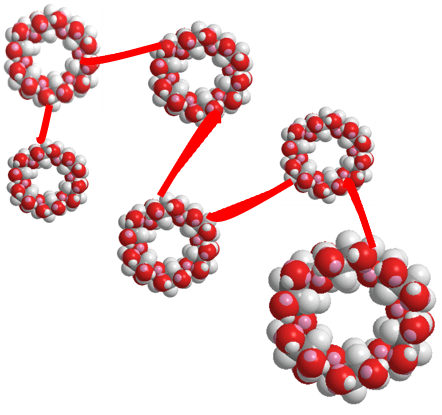
γCDP: Gamma-Cyclodextrin Polymer Materials for Encapsulation, Sensing, and Delivery
キーワード / Keywords
-
γ-シクロデキストリンポリマー / γ-Cyclodextrin Polymer
γ-シクロデキストリンを高分子、ゲル、膜、フレームワークに組み込んだ材料です。大きめの分子空洞を利用し、薬や生体分子、汚染物質を包んだり見分けたりできます。
EN: A material that incorporates γ-cyclodextrin into polymers, gels, membranes, or frameworks. Its relatively large cavity helps encapsulate or recognize drugs, biomolecules, and pollutants. -
包接複合体 / Inclusion Complex
γ-CDの空洞に別の分子が入り込む状態です。水に溶けにくい成分を扱いやすくし、安定化、放出制御、毒性低減などにつながります。
EN: A structure in which another molecule is hosted inside the γ-CD cavity. It can improve solubility, stability, controlled release, and safety. -
分子インプリントポリマー / Molecularly Imprinted Polymer, MIP
目的分子の形を“型”として高分子に記憶させる技術です。抗原やタンパク質を選んで認識でき、センサーの選択性を高めます。
EN: A polymer prepared using a target molecule as a template. It can selectively recognize proteins or other analytes and improve sensor selectivity. -
Pickeringエマルションゲル / Pickering Emulsion Gel
固体粒子や多孔質材料で油と水の界面を安定化したゲルです。薬効成分や抗菌成分を局所に保持し、少しずつ放出する材料に応用できます。
EN: A gel stabilized at oil-water interfaces by particles or porous materials. It can hold active or antimicrobial agents locally and release them gradually. -
薬物送達・創傷治療 / Drug Delivery and Wound Care
薬や有効成分を必要な場所へ届ける考え方です。γ-CD材料は難溶性成分を包み、傷口での抗菌・抗炎症・再生支援に利用できます。
EN: The design of systems that bring active compounds to the needed site. γ-CD materials can encapsulate poorly soluble agents for antimicrobial, anti-inflammatory, and regenerative wound care.
採用した3本 / Three Selected Papers
-
Carbohydrate Polymers(2025 JIF: 13.2)
Carbohydrate polymer-stabilized Pickering emulsion gel coordinates antimicrobial and pro-regenerative cues for scar-minimized wound healing
DOI: 10.1016/j.carbpol.2026.125483 -
Microchemical Journal(2024-2025 Impact Score: 5.40)
A new design for stochastic sensors based on an innovative dual-template molecularly imprinted polymer
DOI: 10.1016/j.microc.2026.119013 -
Journal of Drug Delivery Science and Technology(2025 JIF: 5.2)
HPγCD as a molecular chaperone empowers celastrol: Polymer-free nanofibers combat drug-resistant bacteria
DOI: 10.1016/j.jddst.2026.108741
日本語版
1. 傷あとを抑えるための、γ-CDフレームワーク入りPickeringエマルションゲル
論文: Carbohydrate polymer-stabilized Pickering emulsion gel coordinates antimicrobial and pro-regenerative cues for scar-minimized wound healing
掲載誌: Carbohydrate Polymers
DOI: 10.1016/j.carbpol.2026.125483
- この研究は、抗菌、炎症制御、組織再生を同時に支える創傷被覆材をめざしたものです。
- 材料は、グリチルリチン酸の繊維状ネットワークと、銀を担持したγ-シクロデキストリンフレームワークを組み合わせています。
- さらにフランキンセンス油を含むPickeringエマルションゲルとして設計され、局所で有効成分を保持しやすい構造になっています。
- γ-CDフレームワークは多孔質な“入れ物”として働き、銀イオンを一定期間放出する足場になります。
- ゲルは、抗菌性、細胞へのなじみやすさ、長期安定性、流動特性の面で有望な性質を示しました。
- 動物実験では、傷の閉鎖、コラーゲン再構築、血管新生、炎症の低減に関わる結果が示されています。
- 一般向けに言えば、「γ-CDの小さな穴を持つ材料で抗菌成分を少しずつ出し、傷をきれいに治す方向へ助ける」研究です。
2. γ-CDを組み込んだ分子インプリントセンサーで、心血管疾患バイオマーカーを測る
論文: A new design for stochastic sensors based on an innovative dual-template molecularly imprinted polymer
掲載誌: Microchemical Journal
DOI: 10.1016/j.microc.2026.119013
- この研究は、心血管疾患の予後に関わるTNF-αとCRPを測るための、新しい確率論的センサーを開発したものです。
- センサーは、銀ナノスフェアとγ-CDで修飾したガラス状炭素電極の上に、分子インプリントポリマーを電解重合して作られています。
- TNF-αとCRPを“型”として使い、その後に型分子を取り除くことで、対象分子を選びやすい認識部位を高分子内に作ります。
- γ-CDは、電極表面での分子の取り込みや局所構造形成を助ける成分として組み込まれています。
- 血液のような複雑な試料でも、ELISA法とよく対応する結果が得られ、スクリーニング用途の可能性が示されています。
- ラベルを付けず、リアルタイムに近い形で測れる点が、将来のポイントオブケア検査に向いています。
- 一般向けに言えば、「高分子に“分子の型”を覚えさせ、γ-CDも使って血液中の目印を読み取る小型センサー」の研究です。
3. HPγCDだけで作るナノファイバーが、難溶性天然物を届け、耐性菌感染に挑む
論文: HPγCD as a molecular chaperone empowers celastrol: Polymer-free nanofibers combat drug-resistant bacteria
掲載誌: Journal of Drug Delivery Science and Technology
DOI: 10.1016/j.jddst.2026.108741
- この研究は、水に溶けにくく毒性が課題となるセラストロールを、2-ヒドロキシプロピル-γ-シクロデキストリン(HPγCD)で包み、ナノファイバー創傷被覆材にしたものです。
- 有機溶媒や追加ポリマーを使わず、水だけを溶媒として作る点が、環境負荷の小さい設計として注目されます。
- HPγCDの広い空洞がセラストロールを深く包み、安定な包接複合体をつくることが示されています。
- ナノファイバーは水に触れるとすばやく濡れ、速やかに溶けるため、有効成分を迅速に放出できます。
- 包接によって、セラストロールによる溶血性や細胞毒性が抑えられ、線維芽細胞の移動も促されました。
- シプロフロキサシンと組み合わせることで、MRSAに対する相乗的な抗菌作用も示されています。
- 一般向けに言えば、「HPγCDが薬の付き添い役になり、難溶性天然物を傷口へ届ける、環境にやさしいナノ繊維」の研究です。
まとめ
今回の3本から、γCDP関連材料は、創傷治療、バイオマーカー検出、難溶性成分の送達という異なる場面で使えることがわかります。共通しているのは、γ-CDの大きな空洞や高分子・フレームワーク構造を利用して、分子を包む、見分ける、少しずつ放出するという機能を引き出している点です。
English Version
1. A γ-CD framework Pickering emulsion gel for scar-minimized wound healing
Paper: Carbohydrate polymer-stabilized Pickering emulsion gel coordinates antimicrobial and pro-regenerative cues for scar-minimized wound healing
Journal: Carbohydrate Polymers
DOI: 10.1016/j.carbpol.2026.125483
- This study aims to create an advanced wound dressing that combines antimicrobial, anti-inflammatory, and regenerative functions.
- The material integrates glycyrrhizic acid fibrillar networks with silver-loaded γ-cyclodextrin frameworks.
- It is formulated as a Pickering emulsion gel containing frankincense oil, allowing active compounds to be retained locally.
- The γ-CD framework functions as a porous carrier that supports sustained silver-ion release.
- The gel shows promising antibacterial activity, cytocompatibility, rheological behavior, and long-term colloidal stability.
- In animal studies, it promoted wound closure, collagen remodeling, angiogenesis, and reduced inflammatory infiltration.
- For general readers, this is a γ-CD-based porous gel that gradually releases antimicrobial components to support cleaner wound repair.
2. A γ-CD-assisted molecularly imprinted polymer sensor for cardiovascular biomarkers
Paper: A new design for stochastic sensors based on an innovative dual-template molecularly imprinted polymer
Journal: Microchemical Journal
DOI: 10.1016/j.microc.2026.119013
- This study develops a stochastic sensor for detecting TNF-α and CRP, two biomarkers associated with cardiovascular disease prognosis.
- The sensor is fabricated on a glassy carbon electrode modified with silver nanospheres and γ-cyclodextrin.
- A dual-template molecularly imprinted polymer is electropolymerized using TNF-α and CRP as template molecules.
- After removing the templates, the polymer retains recognition sites that selectively interact with the target biomarkers.
- γ-CD contributes to the modified electrode interface and supports molecular recognition within the sensing platform.
- Measurements in whole blood showed strong agreement with ELISA, suggesting potential for screening and point-of-care use.
- In simple terms, the sensor uses a “molecular memory” polymer and γ-CD-assisted electrode design to read disease-related markers from complex samples.
3. Polymer-free HPγCD nanofibers for delivering celastrol against drug-resistant bacteria
Paper: HPγCD as a molecular chaperone empowers celastrol: Polymer-free nanofibers combat drug-resistant bacteria
Journal: Journal of Drug Delivery Science and Technology
DOI: 10.1016/j.jddst.2026.108741
- This study uses 2-hydroxypropyl-γ-cyclodextrin (HPγCD) to encapsulate celastrol, a poorly water-soluble phytochemical with toxicity concerns.
- The formulation is made as polymer-free electrospun nanofibers using water as the only solvent, without organic additives.
- HPγCD’s expanded cavity deeply encapsulates celastrol and forms a stable inclusion complex.
- The nanofibers become wet instantly and dissolve rapidly on contact with aqueous environments, enabling quick release.
- Encapsulation reduces celastrol-induced hemolysis and cytotoxicity and supports fibroblast migration.
- In combination with ciprofloxacin, the dressing shows synergistic antibacterial activity against MRSA while retaining antioxidant capacity.
- For general readers, HPγCD acts like a molecular escort that helps a difficult-to-use natural compound reach a wound site in a safer, greener format.
Overall Takeaway
The three selected studies show that γCDP-related materials can work in wound care, biomarker sensing, and poorly soluble compound delivery. Their shared principle is molecular recognition: γ-CD cavities and polymer/framework architectures help capture, identify, stabilize, and release functional molecules in useful ways.
文献 / References
- Bello, M. G.; Qiao, Z.; Chen, L. Carbohydrate polymer-stabilized Pickering emulsion gel coordinates antimicrobial and pro-regenerative cues for scar-minimized wound healing. Carbohydrate Polymers 387 (2026), 125483. DOI: 10.1016/j.carbpol.2026.125483.
- Stefan-van Staden, R. I.; Georgescu-State, R.; Gheorghe, D. C.; Gifu, I. C. A new design for stochastic sensors based on an innovative dual-template molecularly imprinted polymer. Microchemical Journal 228 (2026), 119013. DOI: 10.1016/j.microc.2026.119013.
- Su, J.; Liang, J.; Gan, Y.; Guo, Y.; Song, H.; Huang, H.; Duan, C.; Liu, C.; Sun, H.; Guo, X. HPγCD as a molecular chaperone empowers celastrol: Polymer-free nanofibers combat drug-resistant bacteria. Journal of Drug Delivery Science and Technology 125 (2026), 108741. DOI: 10.1016/j.jddst.2026.108741.
選定メモ / Selection Note
- Carbohydrate Polymers:2025 JIF 13.2
- Microchemical Journal:2024-2025 Impact Score 5.40
- Journal of Drug Delivery Science and Technology:2025 JIF 5.2
※AIで生成を行っていることを改めてご了承ください。