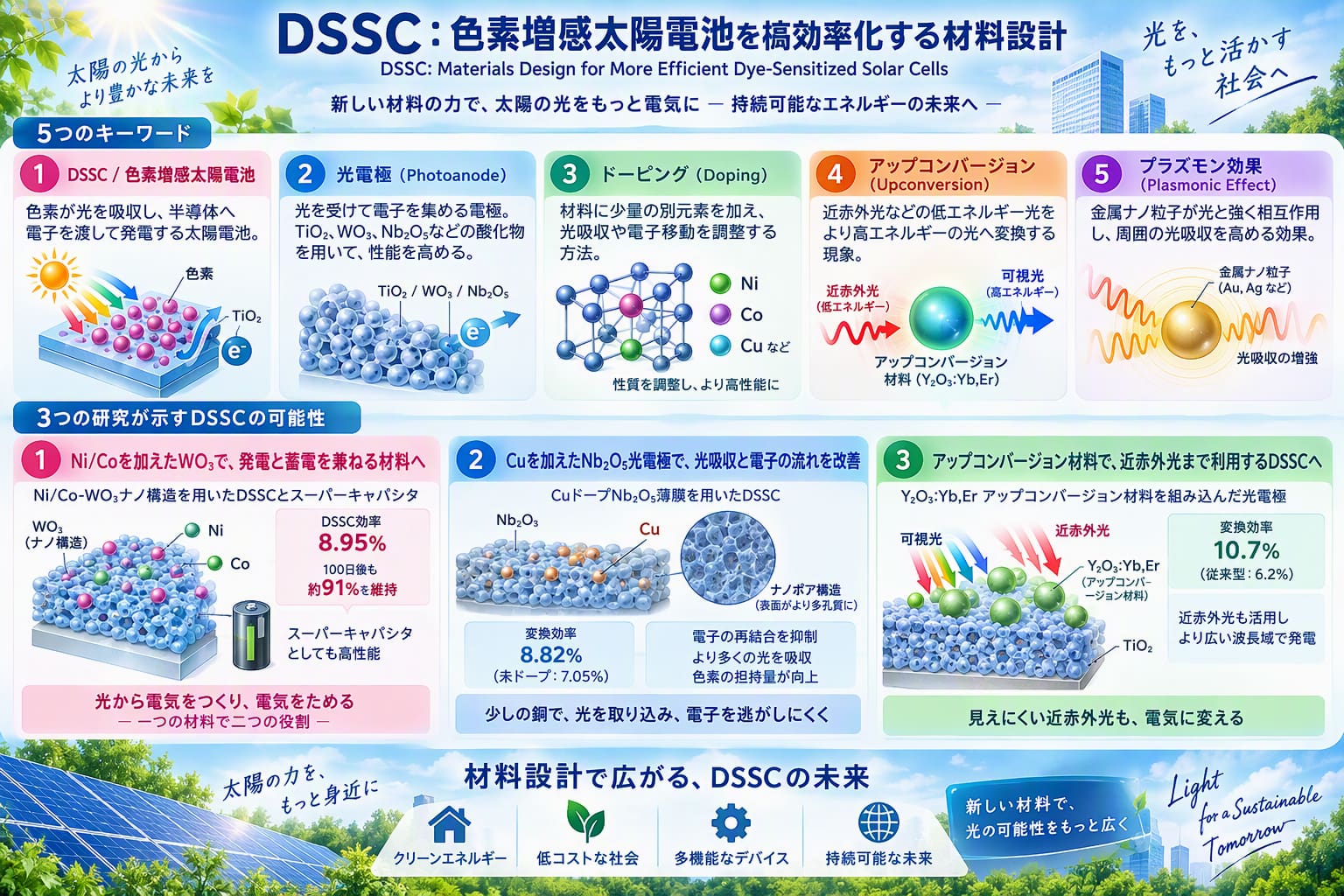
DSSC: Materials Design for More Efficient Dye-Sensitized Solar Cells
キーワード / Keywords
-
DSSC / 色素増感太陽電池
色素が光を吸収し、半導体へ電子を渡して発電する太陽電池です。低コストで作れる可能性があり、材料設計で性能向上が進められています。
EN: A dye-sensitized solar cell generates electricity when a dye absorbs light and transfers electrons to a semiconductor. -
光電極 / Photoanode
光を受けて電子を集める電極です。TiO₂、WO₃、Nb₂O₅などの酸化物を用い、表面構造やドーピングで発電効率を高めます。
EN: A photoanode collects light-generated electrons. Oxide materials such as TiO₂, WO₃, and Nb₂O₅ are commonly engineered for better performance. -
ドーピング / Doping
材料に少量の別元素を加え、光吸収や電子移動を調整する方法です。再結合を抑え、電荷を効率よく取り出すために使われます。
EN: Doping adds small amounts of other elements to tune light absorption, charge transfer, and recombination behavior. -
アップコンバージョン / Upconversion
近赤外光のような低エネルギー光を、より高エネルギーの光へ変換する現象です。DSSCが使える光の範囲を広げる技術として注目されます。
EN: Upconversion converts low-energy light, such as near-infrared light, into higher-energy light that can contribute to solar-cell operation. -
プラズモン効果 / Plasmonic Effect
金属ナノ粒子が光と強く相互作用し、周囲の光吸収を高める効果です。DSSCでは色素の光吸収補助や電流増加に利用されます。
EN: The plasmonic effect enhances local light absorption around metal nanoparticles, helping dyes generate more charge carriers.
日本語版
1. Ni/Coを加えたWO₃で、発電と蓄電を兼ねる材料へ
論文: Enhanced Charge Transfer and Energy Storage Performance of Ni/Co-WO3 Nanostructures for DSSC and Supercapacitor Applications
掲載誌: Journal of Inorganic and Organometallic Polymers and Materials
DOI: 10.1007/s10904-026-04450-2
- この研究では、WO₃とNi/Coを共ドープしたWO₃ナノ構造を水熱合成で作り、DSSCとスーパーキャパシタの両方に使えるかを調べています。
- WO₃は、電子の移動、電荷再結合の抑制、電荷収集の面で光電極材料として有望です。
- NiとCoを加えることで、粒子間のつながり、可視光吸収、電荷の移動が改善されました。
- バンドギャップは2.34 eVから2.19 eVへ小さくなり、より広い範囲の光を利用しやすくなっています。
- Ni/Co-WO₃を使ったDSSCでは、変換効率8.95%が示され、WO₃単独やPtベースの比較デバイスを上回りました。
- 100日後にも初期効率の約91%を維持し、安定性の面でも有望です。
- さらに、スーパーキャパシタとしても高い比容量とサイクル安定性を示しました。
- 一般向けに言えば、「光から電気を作る役割と、電気をためる役割を同じ材料で担わせる」研究です。
2. Cuを加えたNb₂O₅光電極で、光吸収と電子の流れを改善する
論文: Enhancing light absorption and charge carrier dynamics in dye sensitized solar cells using Cu:Nb2O5 photoanodes
掲載誌: Materials Research Bulletin
DOI: 10.1016/j.materresbull.2026.114358
- DSSCの性能を上げるには、光をよく吸収し、色素を多くのせ、電荷の再結合を抑える光電極が必要です。
- この研究では、CuをドープしたNb₂O₅薄膜を光電極として使い、DSSCの発電性能を調べています。
- Cuドーピングにより、Nb₂O₅の結晶構造にひずみが入り、表面のナノポア形成や粒子サイズの変化が起こりました。
- 表面が親水化し、粗さも増すことで、色素の担持や電解液の浸透に有利な状態になりました。
- 発光測定では、Cuドーピングによって電子と正孔の再結合が抑えられることが示されています。
- 5 wt% Cu:Nb₂O₅を用いたDSSCでは、変換効率8.82%が得られ、未ドープNb₂O₅の7.05%を上回りました。
- 電子寿命が長くなり、再結合に関わる抵抗も改善されています。
- 一般向けに言えば、「太陽電池の受け皿となる酸化物に少し銅を加え、光を受け取りやすく、電子を逃がしにくくする」研究です。
3. アップコンバージョン材料で、近赤外光まで利用するDSSCへ
論文: Bifunctional Y2O3: Yb, Er upconverter integrated photoanode for broadband dye sensitized solar cells
掲載誌: Inorganic Chemistry Communications
DOI: 10.1016/j.inoche.2026.117316
- 通常のDSSCは、色素が吸収できる波長の光を中心に発電します。
- この研究では、Y₂O₃:Yb,Erアップコンバージョンナノ蛍光体をTiO₂光電極に組み込み、より広い波長の光を使えるDSSCを目指しています。
- アップコンバージョン材料は、近赤外光をより高エネルギーの光へ変換できるため、DSSCの光利用範囲を広げる可能性があります。
- Y₂O₃:Yb,ErをTiO₂上に滴下し、1〜7 wt%の濃度で性能を比較しました。
- 可視域での反射低下や吸収範囲の拡大が見られ、光散乱とアップコンバージョンが発電に寄与すると考えられます。
- 5 wt%のY₂O₃:Yb,Erを組み込んだDSSCでは、1 sunと近赤外照射の組み合わせで約10.7%の効率が示され、従来型DSSCの約6.2%を上回りました。
- 色素N719の光利用を補助し、広帯域で光を集める設計として有効です。
- 一般向けに言えば、「目に見えにくい近赤外光も、太陽電池が使いやすい光に変えて発電に加える」研究です。
まとめ
DSSCの性能向上には、色素だけでなく、光電極やナノ材料の設計が重要です。Ni/Co-WO₃は、発電と蓄電をつなぐ多機能材料として注目されます。Cu:Nb₂O₅は、光吸収、色素担持、電荷再結合抑制を通してDSSCの効率を高めます。Y₂O₃:Yb,Erアップコンバーターは、近赤外光まで利用する広帯域DSSCの可能性を示しています。これらの研究は、太陽光をより多く、よりむだなく電気へ変えるための材料設計の広がりを示しています。
English Version
1. Ni/Co-doped WO₃ as a material for both energy conversion and storage
Paper: Enhanced Charge Transfer and Energy Storage Performance of Ni/Co-WO3 Nanostructures for DSSC and Supercapacitor Applications
Journal: Journal of Inorganic and Organometallic Polymers and Materials
DOI: 10.1007/s10904-026-04450-2
- This study synthesizes WO₃ and Ni/Co co-doped WO₃ nanostructures using a hydrothermal method.
- The materials are evaluated for both dye-sensitized solar cells and asymmetric supercapacitors.
- WO₃ is attractive as a photoelectrode because it supports electron transport, charge collection, and recombination resistance.
- Ni/Co co-doping improves interparticle connectivity, visible-light absorption, and charge-transfer behavior.
- The band gap decreases from 2.34 eV to 2.19 eV, helping the material use a broader light range.
- The Ni/Co-WO₃-based DSSC reaches a power conversion efficiency of 8.95%, higher than pristine WO₃ and a Pt-based comparison device.
- The device keeps about 91% of its initial efficiency after 100 days.
- The same material also shows promising supercapacitor performance.
- In simple terms, this work explores one material platform that can help generate and store electricity.
2. Cu-doped Nb₂O₅ photoanodes for better light absorption and charge flow
Paper: Enhancing light absorption and charge carrier dynamics in dye sensitized solar cells using Cu:Nb2O5 photoanodes
Journal: Materials Research Bulletin
DOI: 10.1016/j.materresbull.2026.114358
- Improving DSSC performance requires photoanodes that harvest light efficiently, adsorb dyes well, and suppress charge recombination.
- This study fabricates DSSCs using Cu-doped Nb₂O₅ films as photoanodes.
- Cu doping retains the orthorhombic Nb₂O₅ structure while introducing lattice distortion.
- Doping also promotes nanopore formation, surface roughness, and hydrophilicity.
- These surface changes favor dye loading and electrolyte penetration.
- Photoluminescence quenching indicates reduced electron-hole recombination after Cu doping.
- A 5 wt% Cu:Nb₂O₅ photoanode gives a power conversion efficiency of 8.82%, compared with 7.05% for the pristine system.
- Longer electron lifetime and improved recombination behavior explain the performance gain.
- In simple terms, adding a small amount of copper helps the oxide photoanode catch light and move electrons more effectively.
3. Upconversion materials for broadband DSSCs
Paper: Bifunctional Y2O3: Yb, Er upconverter integrated photoanode for broadband dye sensitized solar cells
Journal: Inorganic Chemistry Communications
DOI: 10.1016/j.inoche.2026.117316
- Conventional DSSCs mainly use light that their dye can absorb directly.
- This study integrates Y₂O₃:Yb,Er upconversion nanophosphors with TiO₂ photoanodes to expand the usable light range.
- Upconversion materials can convert near-infrared light into higher-energy light, helping DSSCs access additional parts of the solar spectrum.
- Y₂O₃:Yb,Er is deposited on TiO₂ at concentrations from 1 to 7 wt%.
- Optical measurements show lower reflectance and broader absorption behavior in the integrated photoanodes.
- With 5 wt% Y₂O₃:Yb,Er, the DSSC reaches about 10.7% efficiency under combined 1 sun and near-infrared illumination, compared with about 6.2% for the conventional cell.
- The improvement is linked to stronger light scattering, upconversion, and better use of the N719 dye.
- In simple terms, this work helps a DSSC use near-infrared light that would otherwise be less useful.
Overall Takeaway
DSSC performance depends strongly on materials design beyond the dye itself. Ni/Co-WO₃ connects photovoltaic conversion with electrochemical storage. Cu:Nb₂O₅ improves light absorption, dye loading, and charge-carrier behavior. Y₂O₃:Yb,Er upconversion materials broaden the usable light range toward the near-infrared. Together, these studies show how nanostructured photoanodes, doping, and light-management strategies can make dye-sensitized solar cells more efficient and versatile.
文献 / References
- Sasireka, G.; Vinoth, R.; Girimurugan, R.; Mylsamy, G. Enhanced Charge Transfer and Energy Storage Performance of Ni/Co-WO3 Nanostructures for DSSC and Supercapacitor Applications. Journal of Inorganic and Organometallic Polymers and Materials (2026). DOI: 10.1007/s10904-026-04450-2.
- Sharmila, T.; Girisun, T. C. S. Enhancing light absorption and charge carrier dynamics in dye sensitized solar cells using Cu:Nb2O5 photoanodes. Materials Research Bulletin 205 (2027), Article 114358. DOI: 10.1016/j.materresbull.2026.114358.
- Kawya, J.; Girisun, T. C. S. Bifunctional Y2O3: Yb, Er upconverter integrated photoanode for broadband dye sensitized solar cells. Inorganic Chemistry Communications 192 (2026), Article 117316. DOI: 10.1016/j.inoche.2026.117316.