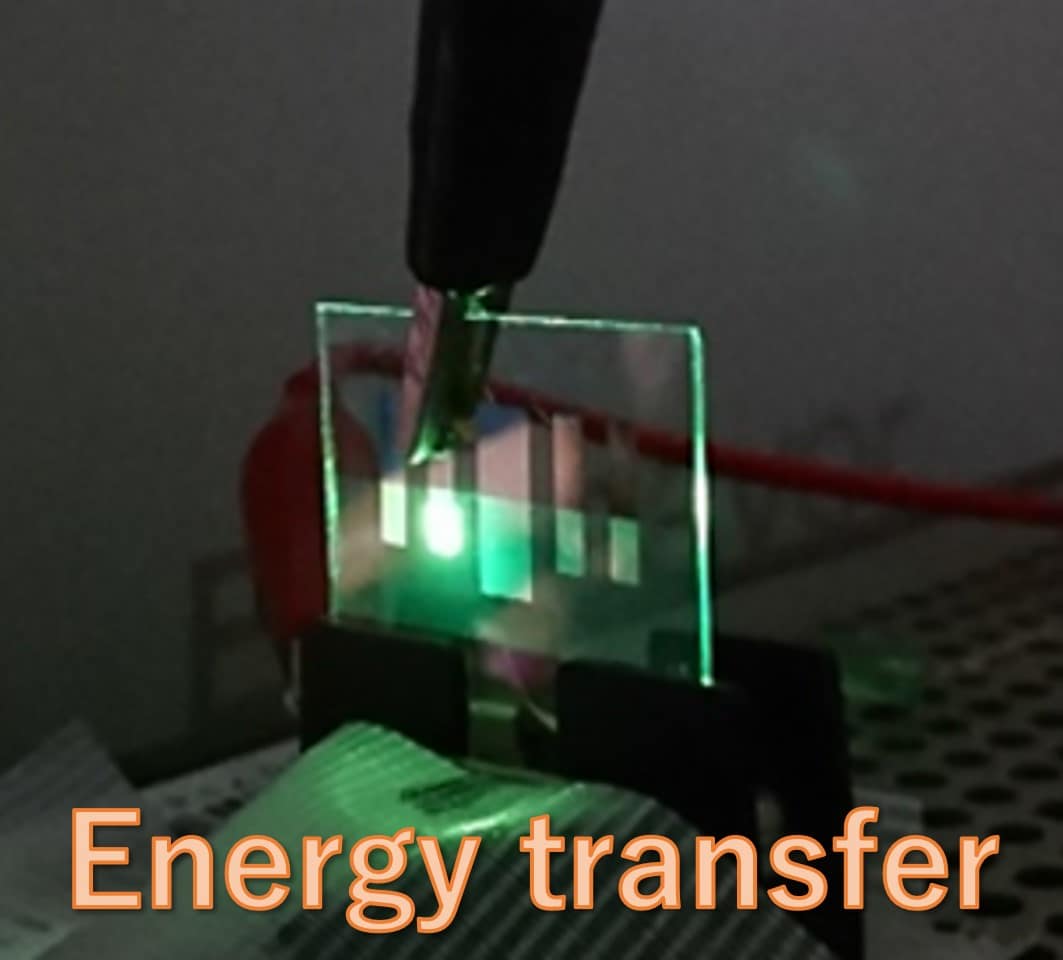
OLED_Energy transfer20260523: A Plain-Language Guide to Energy Transfer and Emission Design in OLEDs
キーワード / Keywords
- エネルギー移動(Energy Transfer)
発光材料のあいだで励起エネルギーが受け渡される現象です。OLEDでは、どの分子へエネルギーを集めるかが、色・効率・寿命を左右します。
EN: The process by which excited-state energy moves between molecules. In OLEDs, controlling where energy ends up strongly affects color, efficiency, and lifetime. - ホール輸送材料(Hole Transport Materials, HTMs)
正孔を発光層まで運ぶ材料です。電子との出会い方を整えることで、発光効率や駆動電圧、素子安定性の改善に役立ちます。
EN: Materials that transport positive charges to the emitting layer. They help improve efficiency, operating voltage, and stability by balancing charges. - MR-TADF(多重共鳴型熱活性化遅延蛍光)
狭い発光スペクトルと高効率を両立しやすい新しい発光設計です。次世代OLEDの高色純度化に重要な技術として注目されています。
EN: A modern emission strategy that combines narrow emission with high efficiency, important for next-generation high-color-purity OLEDs. - 円偏光発光(Circularly Polarized Electroluminescence)
光の振動方向に回転性を持たせた発光です。表示・暗号・3D光学などの新しい光機能へつながる可能性があります。
EN: Emission in which the light carries rotational polarization, offering new possibilities in displays, optical encryption, and 3D photonics. - 溶液プロセス(Solution Processing)
材料を溶液化して薄膜を作る方法です。真空装置への依存を減らし、低コスト・大面積・量産向きのOLED作製法として期待されています。
EN: A fabrication method using solution-based thin-film formation, attractive for lower-cost, large-area, and scalable OLED production.
採用した3本(インパクトファクター順) / Three Selected Papers (by Impact Factor)
- Recent progress on footsteps of organic light emitting diodes by engineering hole transport materials
Coordination Chemistry Reviews (2026), DOI: 10.1016/j.ccr.2026.217961 - [2.2]Paracyclophane-fused organoboron-nitrogen emitters enable efficient solution-processed circularly polarized narrowband electroluminescence
Materials Today (2026), DOI: 10.1016/j.mattod.2026.103347 - Heavy-Atom-Linker Engineering of Dual Multiresonance Emitters for High-Efficiency Solution-Processed Organic Light-Emitting Diodes
ACS Materials Letters (2026), DOI: 10.1021/acsmaterialslett.6c00310
1. OLEDの性能は「光る材料」だけでなく「運ぶ材料」で決まる
Recent progress on footsteps of organic light emitting diodes by engineering hole transport materials
Journal: Coordination Chemistry Reviews
Year: 2026
Type: Review
DOI: 10.1016/j.ccr.2026.217961
日本語でのやさしい解説
- この論文は、OLEDの中で正孔(ホール)を運ぶ材料に注目した総説です。
- OLEDでは、電子と正孔がちょうどよく出会うと効率よく光ります。そのバランスを整えるのがホール輸送材料です。
- 論文では、分子骨格を平らにすること、ヘテロ原子を入れること、エネルギー準位を調整することが、明るさや効率向上につながると整理されています。
- さらに、TADFやリン光発光材料と組み合わせることで、励起子をより有効に使える可能性も示されています。
- 一般向けには、「OLEDは“光る分子”だけでなく、“電気をうまく運ぶ分子”の設計で大きく進歩している」と理解できます。
Plain-Language English Explanation
- This review focuses on hole transport materials, which move positive charges inside OLEDs.
- OLEDs emit efficiently only when electrons and holes meet in the right way, and HTMs help control that balance.
- The paper explains that backbone planarization, heteroatom incorporation, and energy-level tuning can improve brightness and efficiency.
- It also discusses how HTMs can work together with TADF and phosphorescent emitters to use excitons more effectively.
- For general readers, the key idea is that OLED progress depends not only on light-emitting molecules, but also on molecules that guide electricity properly.
2. 円偏光しながら、狭い色幅で、しかも高効率に光るOLEDへ
[2.2]Paracyclophane-fused organoboron-nitrogen emitters enable efficient solution-processed circularly polarized narrowband electroluminescence
Journal: Materials Today
Year: 2026
Type: Article
DOI: 10.1016/j.mattod.2026.103347
日本語でのやさしい解説
- この研究では、[2.2]パラシクロファンというキラルな骨格を取り入れた発光分子を使って、円偏光OLEDを作っています。
- しかも、単に光るだけでなく、発光スペクトルが細い(狭帯域)ため、色の純度が高い点が特長です。
- 分子はMR-TADFの考え方で設計されており、高い発光効率と高い色純度を同時に狙っています。
- 報告では、外部量子効率 25.2% と、溶液プロセス型CP-OLEDとして非常に高い性能が示されています。
- 一般向けには、「未来のディスプレイでは、ただ明るいだけでなく、“向きのある光”を高効率で出す技術が重要になる」ことを感じさせる研究です。
Plain-Language English Explanation
- This study uses a chiral [2.2]paracyclophane framework to build emitters for circularly polarized OLEDs.
- The emitters are also narrowband, meaning they produce purer colors rather than broad emission.
- Their design follows the MR-TADF concept, which aims to combine high color purity with strong efficiency.
- The reported external quantum efficiency of 25.2% is remarkably high for a solution-processed CP-OLED.
- For general readers, this suggests that future displays may not only become brighter, but may also control the “handedness” of light in useful ways.
3. 重い原子をつないで、溶液で作れる高効率OLEDへ
Heavy-Atom-Linker Engineering of Dual Multiresonance Emitters for High-Efficiency Solution-Processed Organic Light-Emitting Diodes
Journal: ACS Materials Letters
Year: 2026
Type: Article
DOI: 10.1021/acsmaterialslett.6c00310
日本語でのやさしい解説
- この研究は、重原子を含むリンカーを分子の中に入れることで、溶液で作りやすく、しかも高効率なOLED発光分子を設計したものです。
- もともとMR-TADF材料は性能が高い一方で、溶けにくさが課題でした。
- そこで、硫黄を含むジベンゾチオフェン系リンカーを使い、溶解性とスピン軌道相互作用の両方を改善しています。
- その結果、溶液プロセスOLEDで最大外部量子効率 26% が達成されました。
- 一般向けには、「高性能だけれど作りにくかった材料を、現実的な作り方へ近づけた研究」と言えます。
- これは、研究室レベルの高性能材料を、将来の量産技術へつなげる一歩として重要です。
Plain-Language English Explanation
- This study designs efficient OLED emitters by introducing a heavy-atom-containing linker into the molecular framework.
- MR-TADF materials are often highly efficient, but they can suffer from poor solubility, which makes solution processing difficult.
- By using a sulfur-containing dibenzothiophene-based linker, the authors improve both solubility and spin-related excited-state control.
- As a result, the solution-processed OLED reached a maximum external quantum efficiency of 26%.
- For general readers, this can be seen as an effort to make high-performance materials more practical to fabricate.
- It is an important step toward connecting excellent laboratory materials with scalable manufacturing methods.
まとめ / Overall Takeaway
日本語
今回選んだ3本から見えてくるのは、OLED研究が単に「光る材料を作る」だけでなく、電荷をどう運ぶか、励起子をどう使うか、そしてどう作りやすくするかまで含めて進化していることです。
ホール輸送材料の総説は基礎設計の重要性を示し、円偏光MR-TADF研究は新しい光機能を示し、重原子リンカー研究は高性能と作りやすさの両立を示しています。
つまり、OLEDの未来は「より明るい」だけでなく、「より美しく、より賢く、より作りやすい」方向へ進んでいるといえます。
English
The three selected papers show that OLED research is no longer just about making molecules that emit light. It is also about how charges are transported, how excitons are harvested, and how devices can be fabricated more practically.
The HTM review highlights the importance of internal charge design, the circularly polarized MR-TADF work points to new optical functions, and the heavy-atom-linker study shows how high performance can be combined with manufacturability.
In short, the future of OLEDs is moving toward devices that are not only brighter, but also purer in color, smarter in function, and easier to make.
文献 / References
- Palem, R. R.; Lee, S.-H.; Kim, H.-S.; Bathula, C. Recent progress on footsteps of organic light emitting diodes by engineering hole transport materials. Coordination Chemistry Reviews 562 (2026), 217961. DOI: 10.1016/j.ccr.2026.217961.
- Wang, J. Q.; Hua, L.; Mo, J. Y.; Zhou, Y. Z.; Duan, P. F.; Lee, J. Y.; Zhu, W. G.; Wang, Y. F. [2.2]Paracyclophane-fused organoboron-nitrogen emitters enable efficient solution-processed circularly polarized narrowband electroluminescence. Materials Today 97 (2026), 103347. DOI: 10.1016/j.mattod.2026.103347.
- Hou, F. X.; Ping, W.; Xia, Z. K.; Jiang, J. C.; Zhang, J. L.; Zhu, W. G.; Liu, Y. C.; Hua, L.; Wang, Y. F. Heavy-Atom-Linker Engineering of Dual Multiresonance Emitters for High-Efficiency Solution-Processed Organic Light-Emitting Diodes. ACS Materials Letters (2026). DOI: 10.1021/acsmaterialslett.6c00310.