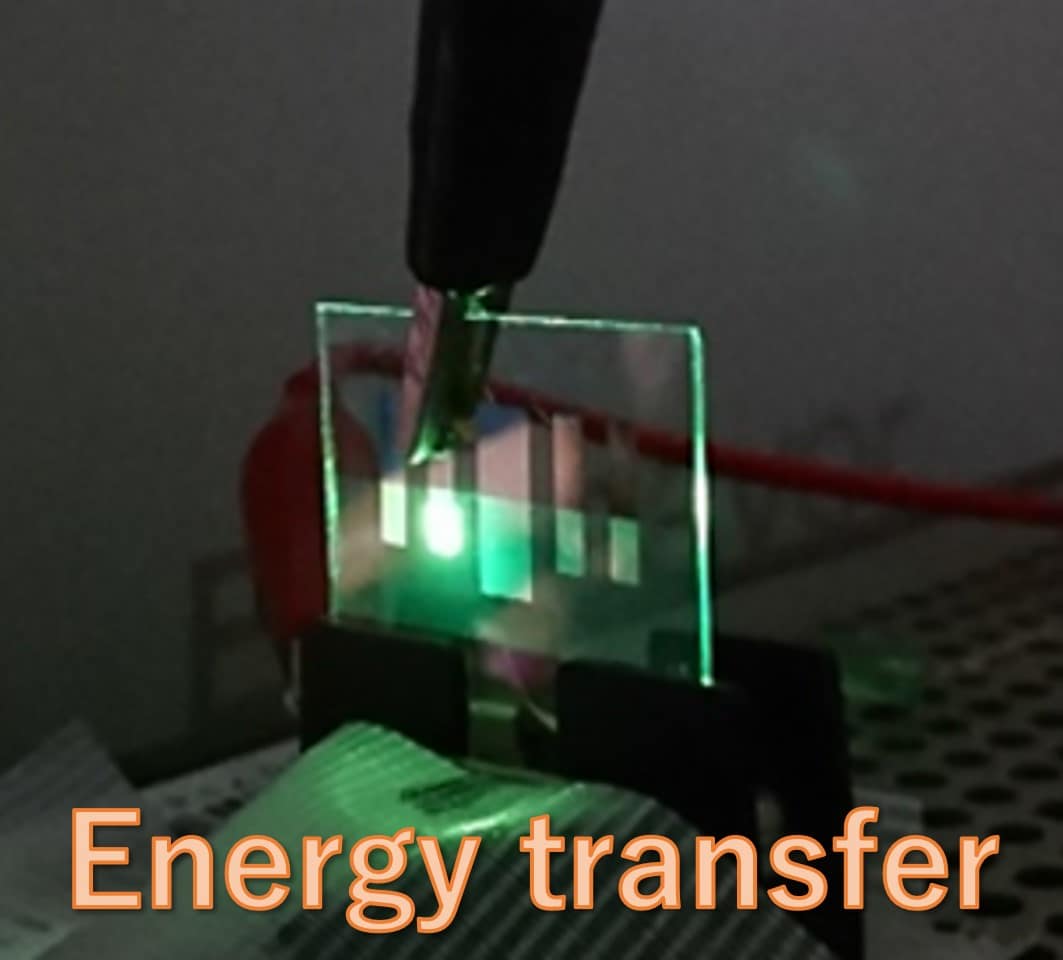
OLED Energy Transfer: Designing Energy Transfer for Efficient Light Emission
キーワード / Keywords
-
OLED / Organic Light-Emitting Diode
有機分子に電気を流して光らせる発光素子です。スマートフォンやテレビの表示に使われ、色純度、効率、寿命の改善が重要です。
EN: An organic light-emitting device driven by electricity. It is used in displays, where color purity, efficiency, and lifetime are key targets. -
エネルギー移動 / Energy Transfer
分子や材料の間で励起エネルギーが移る現象です。OLEDでは、発光分子へ効率よくエネルギーを渡すことで明るさと効率が高まります。
EN: The movement of excitation energy between molecules or materials. In OLEDs, efficient transfer to emitters improves brightness and efficiency. -
Förster移動 / Förster Resonance Energy Transfer
比較的長距離で起こるエネルギー移動です。発光を助ける移動経路として重要で、分子の距離、向き、スペクトルの重なりが効きます。
EN: A relatively long-range energy-transfer process. It depends on distance, molecular orientation, and spectral overlap, and can support efficient emission. -
Dexter移動 / Dexter Energy Transfer
分子が近接したときに起こる短距離のエネルギー移動です。OLEDでは有用な場合もありますが、不要な失活や効率低下を招くこともあります。
EN: A short-range energy-transfer process requiring close molecular contact. It can be useful, but unwanted Dexter transfer may cause losses. -
効率ロールオフ / Efficiency Roll-Off
明るく光らせたときに発光効率が下がる現象です。高輝度ディスプレイでは大きな課題で、励起子の制御や材料設計で抑制します。
EN: A drop in efficiency at high brightness. It is a major challenge for displays and can be reduced by controlling excitons and molecular design.
採用した3本 / Three Selected Papers
-
Advanced Optical Materials(2025 JIF: 7.2)
Low Roll-Off Deep-Blue Hyperfluorescence OLEDs With Sterically Engineered Emitter
DOI: 10.1002/adom.71368 -
Journal of Materials Chemistry C(2025 JIF: 5.1)
Physically driven coupling of defect activation and structural rearrangement in low-temperature In2O3 films via in-cycle Ar plasma
DOI: 10.1039/d6tc01548d -
Dyes and Pigments(2025 JIF: 3.9)
Donor engineering towards high-efficiency red OLED materials with synergistic hot exciton and AIE properties
DOI: 10.1016/j.dyepig.2026.113897
日本語版
1. 立体設計で、深青色OLEDの効率低下を抑える
論文: Low Roll-Off Deep-Blue Hyperfluorescence OLEDs With Sterically Engineered Emitter
掲載誌: Advanced Optical Materials
DOI: 10.1002/adom.71368
- この研究は、深青色OLEDで問題になる「高輝度で効率が下がる」効率ロールオフを抑えるための分子設計です。
- 対象分子pICz-2TPは、多重共鳴型発光分子に立体的な置換基を導入したものです。
- 立体的な設計により、長距離のFörsterエネルギー移動は進みやすく、短距離のDexterエネルギー移動は起こりにくくなるよう制御しています。
- この制御により、発光に使いたいエネルギーを効率よく終端発光分子へ渡し、無駄な失活を抑えます。
- 発光は441 nmの深青色で、半値幅23 nmという狭い発光幅を示し、色純度の高い青色に近づいています。
- デバイスは最大外部量子効率28.0%を示し、1000 cd m⁻²でも16.6%を維持しました。
- 一般向けに言えば、「分子の立体的な形を工夫して、光るためのエネルギーだけをうまく渡し、明るくしても効率が落ちにくい青色OLEDを作る」研究です。
2. 低温In2O3透明電極を、物理的エネルギー移動で高性能化する
論文: Physically driven coupling of defect activation and structural rearrangement in low-temperature In2O3 films via in-cycle Ar plasma
掲載誌: Journal of Materials Chemistry C
DOI: 10.1039/d6tc01548d
- この研究は、次世代OLEDディスプレイに使える透明導電膜として、低温で作製したIn2O3膜を高性能化する方法を示しています。
- OLEDでは、透明で電気をよく流す電極材料が重要ですが、熱に弱い基板やデバイスでは高温処理が使いにくい課題があります。
- 研究では、100℃のPEALD成膜中にArプラズマを導入し、熱の代わりに物理的なエネルギーを膜へ与えています。
- Arプラズマは酸素空孔を選択的に増やし、電子を運ぶキャリアを活性化しました。
- 同時に、結晶化、膜の緻密化、表面平滑化も進み、電気伝導と透明性の両立につながりました。
- 最適条件では低抵抗率と最大84.9%の可視光透過率が得られています。
- 一般向けに言えば、「熱をかけにくいOLED材料でも、プラズマのエネルギーを使って透明電極を低温でよくする」研究です。
3. ホット励起子とAIEを組み合わせ、赤色OLEDの効率を高める
論文: Donor engineering towards high-efficiency red OLED materials with synergistic hot exciton and AIE properties
掲載誌: Dyes and Pigments
DOI: 10.1016/j.dyepig.2026.113897
- この研究は、純有機赤色OLEDで発光効率を高めるため、ドナー部位を工夫した新しい赤色発光分子を開発したものです。
- 通常の蛍光材料では、電気で生じる励起子の一部しか発光に使えないという限界があります。
- TBT-MeとTBT-OMeは、ホット励起子機構を利用し、三重項励起子も発光に活かしやすくする設計です。
- 分子には凝集誘起発光(AIE)の性質もあり、固体中で分子が集まっても発光が弱まりにくい点が特徴です。
- ドナーをメチル基やメトキシ基で変えることで、電子供与性が調整され、赤色発光に必要な光学ギャップが狭くなりました。
- TBT-MeとTBT-OMeを用いたOLEDは、それぞれ最大外部量子効率8.9%と8.6%を示し、参照分子より高性能でした。
- 一般向けに言えば、「赤く光る分子の電子の押し出し方と集まり方を調整し、より多くの励起エネルギーを光に変える」研究です。
まとめ
今回選んだ3本は、OLEDを高効率化するには、発光分子だけでなく、エネルギー移動、励起子の使い方、透明電極まで一体で設計する必要があることを示しています。深青色OLEDではFörster移動とDexter移動のバランス制御、赤色OLEDではホット励起子とAIEの活用、透明電極ではプラズマによる物理的エネルギー移動が鍵になります。いずれも、光を生み出す前後のエネルギーの流れを精密に整える研究です。
English Version
1. Steric engineering suppresses efficiency loss in deep-blue OLEDs
Paper: Low Roll-Off Deep-Blue Hyperfluorescence OLEDs With Sterically Engineered Emitter
Journal: Advanced Optical Materials
DOI: 10.1002/adom.71368
- This study addresses efficiency roll-off in deep-blue hyperfluorescence OLEDs, where efficiency often decreases at high brightness.
- The emitter pICz-2TP is a sterically engineered multi-resonance molecule.
- Its molecular architecture promotes long-range Förster resonance energy transfer while inhibiting short-range Dexter energy transfer.
- This helps deliver excitation energy to the intended terminal emitter while reducing unwanted loss pathways.
- The device shows narrow deep-blue emission at 441 nm with a full width at half maximum of 23 nm.
- It achieves a peak external quantum efficiency of 28.0% and maintains 16.6% at 1000 cd m⁻².
- In simple terms, this work shapes a molecule in three dimensions so that useful energy transfer is favored and harmful energy loss is reduced.
2. Physical energy transfer improves low-temperature In2O3 transparent electrodes
Paper: Physically driven coupling of defect activation and structural rearrangement in low-temperature In2O3 films via in-cycle Ar plasma
Journal: Journal of Materials Chemistry C
DOI: 10.1039/d6tc01548d
- This study develops low-temperature In2O3 transparent conducting films for next-generation OLED displays.
- OLED devices need transparent electrodes that conduct electricity well, but high-temperature processing is difficult for heat-sensitive substrates.
- The researchers use in-cycle Ar plasma during PEALD growth at 100 °C to provide physical energy in place of thermal energy.
- Ar plasma selectively increases oxygen vacancies, activating donor-like carriers without greatly changing overall O/In stoichiometry.
- It also promotes crystallization, densification, texture development, and surface smoothing.
- The optimized film achieves low resistivity and visible transparency up to 84.9%.
- In simple terms, plasma energy helps create transparent electrodes that can be made under low-temperature conditions suitable for OLED-related devices.
3. Hot excitons and AIE improve red OLED emission efficiency
Paper: Donor engineering towards high-efficiency red OLED materials with synergistic hot exciton and AIE properties
Journal: Dyes and Pigments
DOI: 10.1016/j.dyepig.2026.113897
- This study designs red organic emitters that use both hot-exciton behavior and aggregation-induced emission.
- Conventional fluorescent OLED materials cannot use all electrically generated excitons efficiently.
- TBT-Me and TBT-OMe are designed to harvest triplet excitons through hot-exciton pathways.
- Their aggregation-induced emission behavior helps maintain emission in the solid state, where many molecules usually suffer from quenching.
- Donor functionalization with methyl or methoxy groups strengthens electron donation, narrows the optical bandgap, and supports red emission.
- OLEDs using TBT-Me and TBT-OMe reach peak external quantum efficiencies of 8.9% and 8.6%, outperforming the reference molecule.
- For general readers, this work tunes how red-emitting molecules donate electrons and pack together so more excitation energy becomes light.
Overall Takeaway
The three selected papers show that high-performance OLEDs require control over energy flow at several levels. Deep-blue OLEDs benefit from selective Förster and Dexter energy-transfer control. Red OLEDs benefit from hot-exciton harvesting and aggregation-induced emission. Transparent electrode films benefit from plasma-assisted physical energy transfer during low-temperature growth. Across these studies, the central idea is the same: better OLEDs come from managing where energy goes, how it moves, and how efficiently it becomes light.
文献 / References
- Qiu, L.; Zhang, X.; Li, H.; Wu, Z.; Lin, J.; Huang, J.; Wang, G. Low Roll-Off Deep-Blue Hyperfluorescence OLEDs With Sterically Engineered Emitter. Advanced Optical Materials (2026). DOI: 10.1002/adom.71368.
- Kim, T.-K.; Gwoen, J.-H.; Oh, M. H.; Baek, J.-H.; Jang, J.; Lee, M.; Kim, H.; Park, J.-S. Physically driven coupling of defect activation and structural rearrangement in low-temperature In2O3 films via in-cycle Ar plasma. Journal of Materials Chemistry C (2026). DOI: 10.1039/d6tc01548d.
- Suo, X.; Wang, R.; Jiang, K.; Mahmood, Z.; Hu, D.; Yang, G.-X.; Huo, Y.; Su, S.-J.; Ji, S.; Ma, Y. Donor engineering towards high-efficiency red OLED materials with synergistic hot exciton and AIE properties. Dyes and Pigments 254 (2026), 113897. DOI: 10.1016/j.dyepig.2026.113897.
選定メモ / Selection Note
- Advanced Optical Materials:2025 JIF 7.2。
- Journal of Materials Chemistry C:2025 JIF 5.1。
- Dyes and Pigments:2025 JIF 3.9。
- 添付ファイル内には、Chemistry – A European Journal、Physical Chemistry Chemical Physics、ChemPhotoChem、Applied Catalysis A: GeneralなどのOLED・発光・材料関連論文も含まれていました。本稿では、添付ファイル内限定を守りつつ、OLED energy transferとの関連性が明確で、かつジャーナル指標が高い3本を優先しました。