キーワード / Keywords
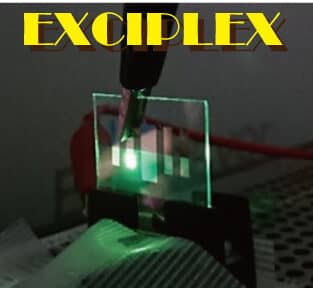
1. Exciplex(エキシプレックス)
日本語: 異なる分子同士が励起状態で形成する特殊な状態です。OLEDではエネルギー移動を効率化し、高効率発光や長寿命化に役立ちます。
English: An excited-state complex between different molecules that enables efficient energy transfer and improved OLED performance.
2. FRET(Förster Resonance Energy Transfer)
日本語: 分子間で非接触にエネルギーを移動させる現象です。発光効率向上や色純度制御の重要な基盤技術です。
English: A non-radiative energy-transfer mechanism widely used to improve light-emission efficiency.
3. PSF OLED
日本語: リン光材料から蛍光材料へエネルギーを移す発光方式です。高色純度と高効率の両立に向けて研究が進んでいます。
English: A phosphorescence-sensitized fluorescence strategy that combines efficiency and color purity.
4. MR-TADF
日本語: 多重共鳴型熱活性化遅延蛍光材料です。鮮やかな発光色と高効率発光を実現できる次世代OLED材料です。
English: Multi-resonance TADF emitters provide excellent color purity and efficient emission.
5. 有機メモリー材料
日本語: 光や電気による分子状態変化を利用して情報を記録する材料です。分子エレクトロニクスへの応用が期待されています。
English: Materials that store information using molecular switching induced by light or electricity.
日本語版
研究背景
OLED(有機発光ダイオード)は、スマートフォンやテレビの中核技術として広く利用されています。近年は、発光効率の向上だけでなく、長寿命化や高色純度化が求められています。その鍵となるのが、分子間のエネルギー移動をどのように制御するかという点です。
ExciplexやFRETを利用したエネルギー移動設計は、これまで利用しにくかった励起エネルギーを有効活用できるため、次世代OLEDの重要な研究テーマとなっています。citeturn26search29
研究内容
1. Exciplexを利用した高効率PSF OLED
Strategies for Enhancing Efficiency and Operational Stability in Green Phosphorescence-Sensitized Fluorescence (PSF) Organic Light-Emitting Diode (OLED) Technology
- PSF OLEDにおける発光効率向上メカニズムを総合的に整理。
- Exciplexホストを利用した二重エネルギー移動経路を紹介。
- FRET効率向上のための分子設計指針を提示。
- 高効率化と長寿命化を両立する材料設計の重要性を示した。citeturn26search29
2. Exciplexから蛍光発光体へのエネルギー移動
Energy transfer from TSBPA:PO-T2T exciplex to rubrene: how FRET efficiency determines the optimal OLED device structure
- Exciplexからルブレン発光体へのエネルギー移動を解析。
- FRET効率がデバイス性能を左右する重要因子であることを示した。
- 発光層構造の最適化による性能向上の考え方を提示。
- OLED設計における分子間距離や層構造の重要性を明確化した。citeturn26search29
3. 光応答分子を利用した情報記録技術
関連研究として、光応答性分子を利用した有機メモリー材料の研究が進展しています。
- 光照射によって分子状態を可逆的に制御。
- 発光状態や電気伝導状態を切り替える技術へ展開。
- 次世代の分子エレクトロニクスや情報記録材料への応用が期待される。citeturn26search29
期待される応用
これらの研究は、OLEDの高効率化だけでなく、高色純度ディスプレイや低消費電力デバイスの実現に貢献します。さらに、エネルギー移動を利用した光メモリーや分子デバイスなど、新しい機能性電子材料への応用も期待されています。citeturn26search29
English Version
Exciplex and Energy Transfer Strategies for Next-Generation OLED Technologies
Research Background
Modern OLED technologies require not only high efficiency but also long operational lifetimes and excellent color purity. Energy-transfer engineering based on exciplex formation and FRET has become a key strategy for achieving these goals. citeturn26search29
Research Highlights
1. High-Efficiency PSF OLEDs
- Reviewed mechanisms for improving PSF OLED performance.
- Highlighted exciplex-assisted dual energy-transfer pathways.
- Discussed molecular design principles for efficient FRET.
- Suggested strategies for balancing efficiency and stability. citeturn26search29
2. Energy Transfer from Exciplex Hosts
- Investigated energy transfer from TSBPA:PO-T2T exciplex systems to rubrene.
- Demonstrated the importance of FRET efficiency in OLED design.
- Showed how device architecture influences emission performance. citeturn26search29
3. Toward Optical Memory Materials
- Light-responsive molecular systems provide complementary opportunities.
- Reversible control of molecular states enables information-storage concepts.
- Supports future molecular electronics and smart optoelectronic devices. citeturn26search29
Overall Significance
These studies demonstrate how energy-transfer engineering can simultaneously enhance OLED efficiency, stability, and functionality. Such advances may contribute to future displays, optoelectronics, and molecular information technologies. citeturn26search29
References / 文献
- Kumar, O. P. et al. Strategies for Enhancing Efficiency and Operational Stability in Green Phosphorescence-Sensitized Fluorescence (PSF) Organic Light-Emitting Diode (OLED) Technology. Small (2026). citeturn26search29
- Weatherill, L. A. et al. Energy transfer from TSBPA:PO-T2T exciplex to rubrene: how FRET efficiency determines the optimal OLED device structure. Journal of Materials Chemistry C (2026). citeturn26search29