OLED_TPD_20260523: A Plain-Language Guide to OLED Research Using TPD
キーワード / Keywords
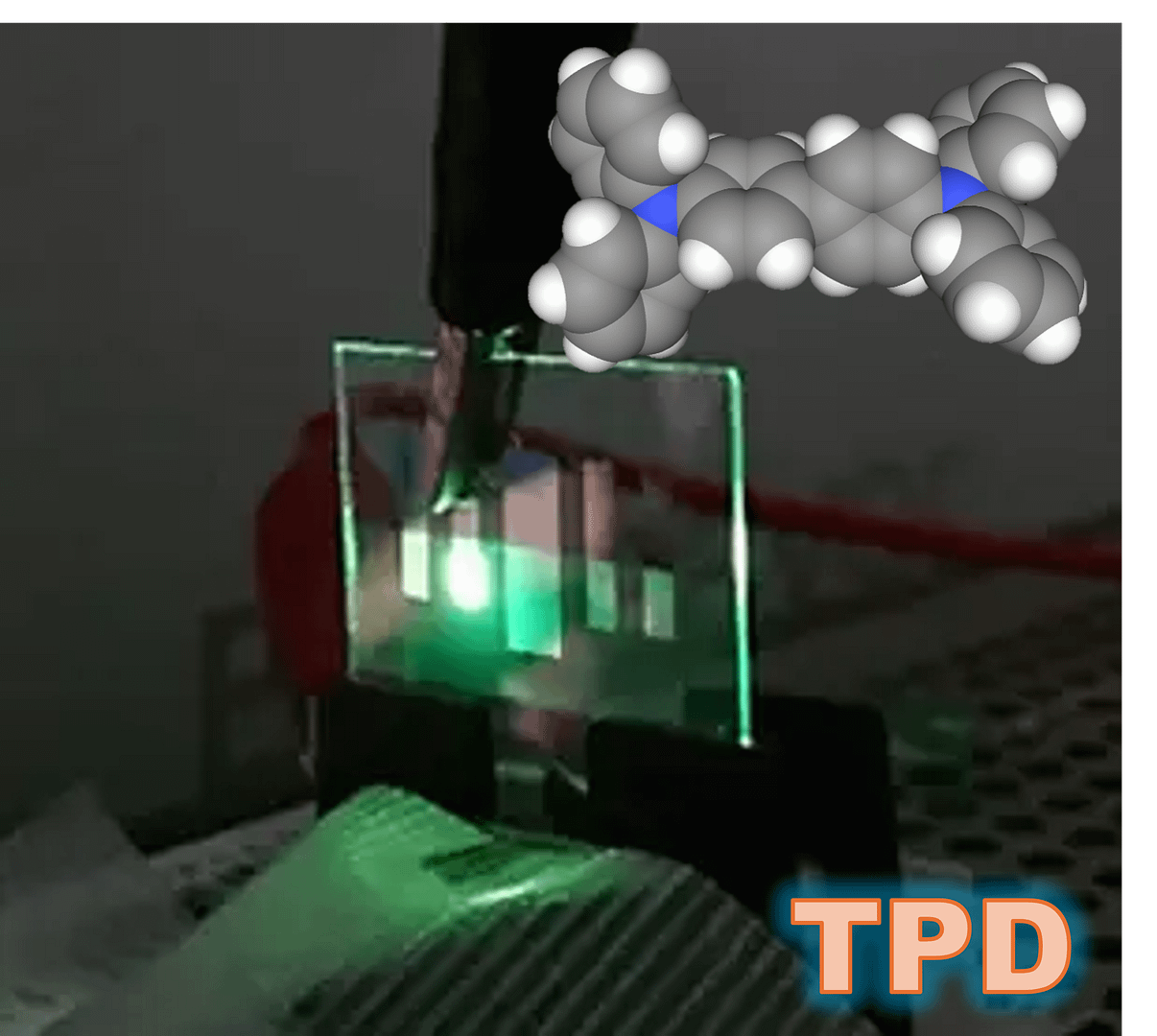
- TPD(ホール輸送材料) / TPD as a Hole-Transport Material
TPDは有機ELの中で正孔を運ぶ代表的な材料です。発光層へ電荷をうまく届けることで、明るさや効率、駆動の安定性に大きく関わります。
EN: TPD is a classic hole-transport material in OLEDs. It helps deliver positive charges efficiently, strongly affecting brightness, efficiency, and stable operation. - ドーピング / Doping
材料に少量の別成分を加えて性質を調整する方法です。電荷の流れや発光のしやすさを最適化でき、OLED性能の向上に役立ちます。
EN: Doping means adding a small amount of another material to tune properties. It can improve charge transport and emission behavior in OLEDs. - ペンタセン添加 / Pentacene Doping
TPD層にペンタセンを加えることで、電荷注入や輸送特性が変わります。混ぜる割合を最適化すると、デバイス効率や安定性の改善が期待されます。
EN: Adding pentacene into the TPD layer changes charge injection and transport. Optimizing the amount can improve efficiency and stability. - Alq3領域の最適化 / Optimization of the Alq3 Region
Alq3は有機ELでよく使われる発光・電子輸送材料です。その周辺設計を調整することで、より明るく効率のよい発光が目指せます。
EN: Alq3 is a well-known OLED material for emission and electron transport. Optimizing its region can improve brightness and device efficiency. - 電流効率 / Current Efficiency
どれだけ少ない電流で明るく光れるかを示す指標です。値が高いほど、省エネルギーで効率よく光る有機ELデバイスといえます。
EN: Current efficiency shows how much light is produced per unit of current. Higher values mean more efficient light emission with less power.
注記 / Note
この原稿は、アップロードされた OLED_TPD_20260523.txt に含まれる情報だけをもとに作成しています。確認できた論文は 1本 でした。そのため、今回は1本を一般向けにわかりやすく紹介する構成です。
This draft is based only on the information contained in OLED_TPD_20260523.txt. Only one paper was found in the uploaded file, so this page focuses on that single paper in a clear and accessible way.
採用した論文 / Paper Used
Fabrication of solution-processed pentacene-doped N,N-bis(3-methylphenyl)-N,N(phenyl)-benzidine (TPD) thin film-based organic light-emitting diode with optimized (8-hydroxy quinolinato) aluminium (Alq3) region
Journal: Bulletin of Materials Science
Year: 2026
Type: Article
DOI: 10.1007/s12034-026-03582-y
日本語でのやさしい解説
- この研究では、TPD薄膜にペンタセンを加えることで、有機ELの性能を改善しようとしています。
- さらに、Alq3を含む発光領域の設計も調整し、より効率よく光るデバイスを目指しています。
- 比較の結果、ペンタセンを12%加えた条件が最も良い性能を示しました。
- そのうえで、発光層側に Ir(mppy)3 を加えて最適化したところ、最大電流効率 13.3 cd/A が得られたと報告されています。
- 研究では、電流と電圧の関係、明るさと電圧の関係、効率評価だけでなく、薄膜の光の通しやすさや表面の様子も観察しています。
- 一般向けに言えば、「材料を少し混ぜる割合や層の作り方を工夫するだけで、有機ELはより明るく、効率よく、安定して光るようになる」ことを示した研究です。
- また、スピンコートによる溶液プロセスを用いているため、比較的簡便で低コストな作製法としても意味があります。
Plain-Language English Explanation
- This study tries to improve OLED performance by adding pentacene into TPD thin films.
- It also adjusts the Alq3-related emitting region to make the device emit light more efficiently.
- The comparison showed that 12% pentacene doping gave the best performance.
- After further optimization with Ir(mppy)3 in the emitting region, the device achieved a maximum current efficiency of 13.3 cd/A.
- The researchers examined current–voltage behavior, luminance–voltage behavior, efficiency, optical transmittance, and surface morphology.
- For general readers, the message is that small changes in material composition and layer design can make OLEDs brighter, more efficient, and more stable.
- Because the device was made by solution processing with spin coating, the work is also relevant to simpler and potentially lower-cost fabrication methods.
この論文の見どころ / Why This Paper Matters
日本語
- OLED研究では、新しい分子を作るだけでなく、既存材料の組み合わせと配合比をどう最適化するかも重要です。
- この論文は、TPD、ペンタセン、Alq3、Ir(mppy)3 という材料の役割を調整することで、性能改善が可能であることを示しています。
- つまり、「どの材料を使うか」だけでなく、どう積み重ね、どう混ぜるかがデバイス性能を左右することをわかりやすく示す研究です。
English
- In OLED research, performance depends not only on inventing new molecules but also on how existing materials are combined and optimized.
- This paper shows that tuning the roles of TPD, pentacene, Alq3, and Ir(mppy)3 can improve device behavior.
- In other words, it clearly demonstrates that how materials are layered and blended is just as important as which materials are chosen.
文献 / Reference
- Saikia, D.; Sarma, R. Fabrication of solution-processed pentacene-doped N,N-bis(3-methylphenyl)-N,N(phenyl)-benzidine (TPD) thin film-based organic light-emitting diode with optimized (8-hydroxy quinolinato) aluminium (Alq3) region. Bulletin of Materials Science 49 (2026), 75. DOI: 10.1007/s12034-026-03582-y.