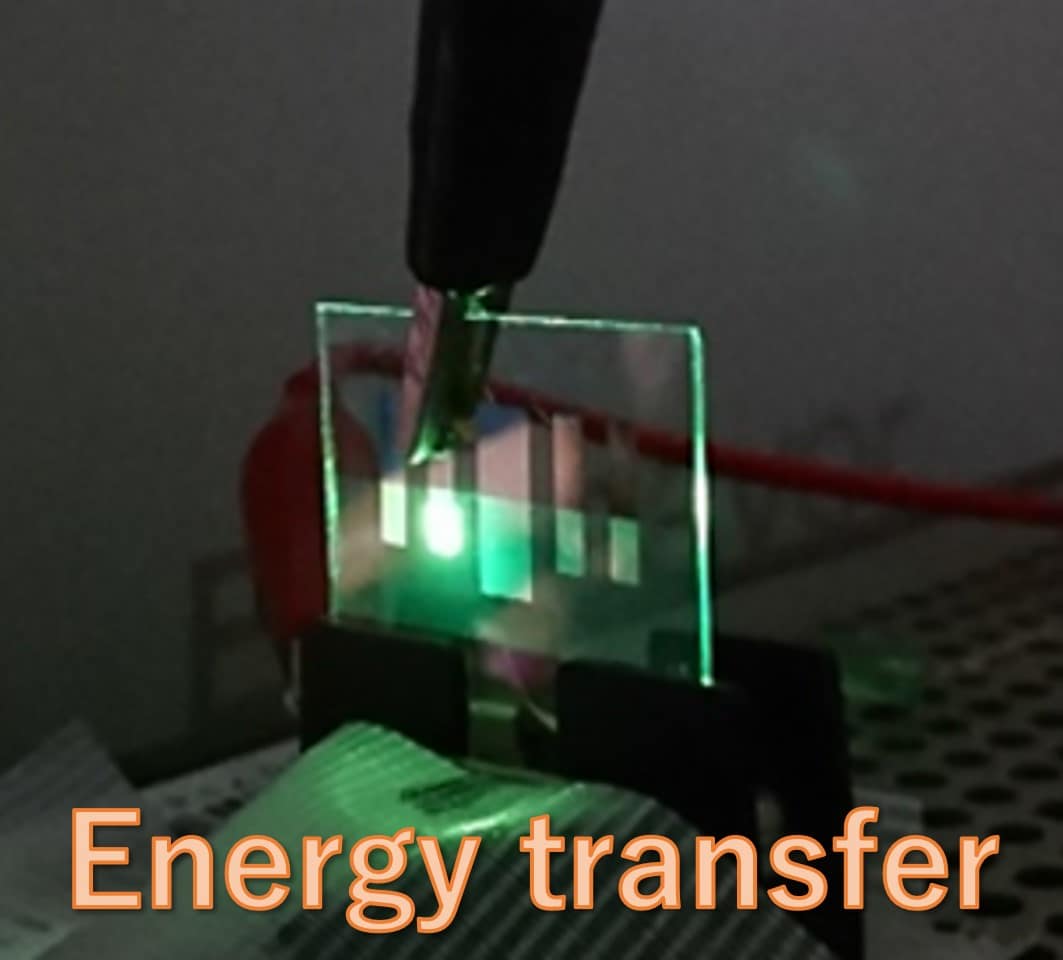
OLED energy transfer: Boosting OLED performance via energy transfer (plain-language overview)
キーワード(Keywords)
- エネルギー移動(Energy transfer):発光役へエネルギーを渡して光に変える仕組み。無駄を減らし高効率化の要。
EN: Passing excitation energy to the final emitter reduces losses and boosts efficiency. - TADF/RISC(TADF / reverse intersystem crossing):三重項を一重項へ戻して光に使う仕組み。材料設計で効率が大きく変わる。
EN: TADF uses RISC to convert triplets into singlets, strongly impacting efficiency. - 増感(sensitizer)と終端発光体(terminal emitter):役割分担で「効率」と「色の純度」を両立する設計思想。
EN: A sensitizer harvests excitons and transfers energy to a narrowband terminal emitter. - 界面損失(interfacial loss):層の境目で励起子が失われる問題。注入・輸送・再結合の設計が鍵。
EN: Excitons can be quenched at interfaces; careful layer engineering is essential. - 効率ロールオフ(efficiency roll-off):明るくすると効率が落ちる現象。実用輝度でも性能を保つ工夫が重要。
EN: Efficiency drop at high luminance; suppressing roll-off is crucial for devices.
1) 階層的なエネルギー整合と界面設計で、深青色ハイパーフルオレッセンスを高効率化
Hierarchical Energetic Coherence and Interfacial Robustness Enable 44.3% EQE Deep-Blue Hyperfluorescent OLEDs
- Journal: ACS Energy Letters(2026, Early Access)
- DOI: https://doi.org/10.1021/acsenergylett.5c04283
日本語(Abstractを直接貼らずに要点化)
- 青色OLEDでは「光を取り出す」だけでなく、電荷注入→輸送→再結合を全体として整える必要がある、と述べています。
- 自己組織化のホール注入層で、界面に“縦方向に整った構造”を作り、界面での励起子損失を抑える考え方を示しています。
- 発光層は、(1)三重項を素早く一重項へ戻す増感剤、(2)高三重項エネルギーのホスト、(3)狭帯域のTADF発光体の組み合わせ、と説明されています。
- その結果として、深青色で EQE 44.3%、発光帯域 19 nm、CIE (0.104, 0.173)、安定性向上を報告しています。
English (Plain-language points)
- The study emphasizes system-level optimization of injection, transport, and recombination for blue OLEDs.
- A self-assembled hybrid hole-injection layer is used to form a robust interface and suppress exciton loss.
- The emissive layer combines a fast triplet-upconverting sensitizer, a high-triplet-energy host, and a narrowband TADF emitter.
- Reported device metrics include EQE 44.3%, 19 nm bandwidth, and deep-blue CIE (0.104, 0.173) with improved stability.
2) 銅(I)錯体のTADFで、深赤〜近赤外へ。機械刺激で色が変わる(メカノクロミズム)
Highly Efficient Mechanochromic Thermally Activated Delayed Fluorescence in the Deep Red to Near-Infrared in Copper(I) [2.2]Isoindolinophanyl-Carbene Carbazolates
- Journal: Angewandte Chemie International Edition(2026, Early Access)
- DOI: https://doi.org/10.1002/anie.5338298
日本語(Abstractを直接貼らずに要点化)
- 深赤〜近赤外の発光は応用が広い一方、エネルギー差が小さいため熱として失われやすい(エネルギーギャップ則)課題がある、と述べています。
- そこでTADFにより放射過程を強め、スピン禁制のリン光に頼らずに発光させる発想を説明しています。
- 銅(I)錯体で、RISC速度が 0.6–21×10⁹ s⁻¹、量子収率が最大 0.8 などの指標を示すと記載されています。
- 結晶/ポリマー中/粉砕(機械刺激)で発光色が深赤〜近赤外へ変わる“メカノクロミズム”を報告し、深赤OLEDの実証にも触れています。
English (Plain-language points)
- Deep-red to near-IR emitters often suffer nonradiative loss due to the energy-gap law, as discussed.
- The work highlights using TADF to enhance radiative decay without relying on spin-forbidden phosphorescence.
- Copper(I) complexes are reported with kRISC = 0.6–21×10⁹ s⁻¹ and quantum yields up to 0.8.
- Emission shifts into deep-red/near-IR upon embedding in polymers or grinding (mechanochromism), and a proof-of-concept deep-red OLED is demonstrated.
3) “分子が近接して相互作用する”TSCTで、青色発光の効率と安定性を両立
Noncovalent through-space charge transfer enables efficient and stable blue electroluminescence
- Journal: Science Advances(2026)
- DOI: https://doi.org/10.1126/sciadv.adz5381
日本語(Abstractを直接貼らずに要点化)
- 青色OLEDでは「高効率」と「長寿命」の両立が難題であり、ドナー・アクセプター型TADFでの電荷移動の制御が重要だと述べています。
- 分子内の結合を介さず、面と面が近づいた配置で生じるTSCT(through-space charge transfer)を活用する戦略を提案しています。
- OLEDは 468 nm の青色発光で、EQE 32.3%、ロールオフが小さいこと、さらに T90=198.2 h(初期輝度1000 cd/m²) の安定性を示すと記載されています。
- また、同分子を増感剤にした「TADF増感蛍光OLED」で、EQE 36.6%、狭帯域、T90>87.8 h(1000 cd/m²) を報告しています。
English (Plain-language points)
- Efficient and stable blue emission remains challenging; controlling charge transfer in donor–acceptor TADF materials is key.
- The paper leverages through-space charge transfer (TSCT) enabled by face-to-face donor–acceptor proximity.
- Reported OLED metrics include 468 nm emission, EQE 32.3% with minimal roll-off, and T90 = 198.2 h at 1000 cd/m².
- A TADF-sensitized fluorescent OLED using the molecule as a sensitizer reaches EQE 36.6% with narrowband emission and T90 > 87.8 h at 1000 cd/m².
文献(References)
- Kwon, Hyuk Bin et al. Hierarchical Energetic Coherence and Interfacial Robustness Enable 44.3% EQE Deep-Blue Hyperfluorescent OLEDs. ACS Energy Letters (2026). https://doi.org/10.1021/acsenergylett.5c04283
- Muthig, Andre M. T. et al. Highly Efficient Mechanochromic Thermally Activated Delayed Fluorescence in the Deep Red to Near-Infrared in Copper(I) [2.2]Isoindolinophanyl-Carbene Carbazolates. Angewandte Chemie International Edition (2026). https://doi.org/10.1002/anie.5338298
- Tao, Wei et al. Noncovalent through-space charge transfer enables efficient and stable blue electroluminescence. Science Advances (2026). https://doi.org/10.1126/sciadv.adz5381